Chemical free produce and pasture-pure meats
from the Quaker Farm Store...
Quaker Farm Home
Contact & Visitor Info
Quaker Bee Honey
Free Range Eggs
Quaker Soaps
Chemical free Hay
Wool & Fiber
Garden Produce
Pastured Chicken
Pastured Turkey
Pasture-raised Beef
Grass fed Lamb & Mutton
Pasture-raised Goat Meat (chevon)
Buff Orpington
Chickens
Border Leicester & Cotswold
Sheep
Saanen & Oberhasli
Dairy Goats
Checkered Giant
Rabbits
AKC Collies
Quaker Pantry
Recipes & more!
Simple Living Workshops
Learn more about life
on the farm!
Click here to read
Quaker Anne's
Children's Stories
Stories include:
How Bees Make Honey
A Chicken is Born
A Haircut for Sheep
A Baby Horse is Born
A Baby Goat is Born
Lassie Saves a Lamb
|
Quaker Hill Farm
Harrisville, Michigan
quakerfarm.com
Pastured Goose & Duck
We have pasture raised goose and duck available in late summer and early fall. Our old fashioned method
for raising geese and ducks mean all are free range and chemical free - and that provides you with healthy
and nutritional food value! Goose ranges in size from about 6 - 12 pounds dressed. Duck vary in size.
Place your order early for assured availability - we sell out every year!
| Comparisons |
Moisture % |
Protein % |
Crude Fat % |
Energy
cal/100g |
Cholesterol*
mg/100 |
Goose, domestic,
flesh only, roasted |
60.0 |
33.3 |
9.6 |
220 |
62.5 |
Turkey, all classes,
flesh only, roasted |
61.4 |
31.5 |
6.1 |
190 |
82 |
Chicken, roaster,
flesh only, roasted |
63.0 |
29.5 |
6.3 |
183 |
60 |
Duck, domestic, total
edible roasted |
52.3 |
22.8 |
23.6 |
310 |
70 |
Pork, loin chop, lean
and fat, cooked |
43.9 |
29.4 |
25.6 |
357 |
70 |
Beef, ribeye steak,
cooked |
39.7 |
19.9 |
39.4 |
440 |
70 |
Beef, hamburger,
lean, cooked |
64.6 |
30.1 |
4.0 |
163 |
70 |
Perch, Atlantic
breaded & fried |
58.9 |
19.0 |
13.3 |
227 |
60 |
Salmon, Chinook,
canned |
63.9 |
19.6 |
14.0 |
210 |
60 |
| * Cholesterol values
are for raw meats - data unavailable for cooked products |
Muscovy Ducks
Fertile Duck Eggs: $2.50 each
Ducklings: $5.00 - $7.00 each - depending on age, straight run only.
Adults: 12 weeks and up - $10.00 each
General Information
A top choice for homesteaders, Muscovy ducks are easy to manage, quiet birds that are simply a delight to own.
They are personable, intelligent and calm. Muscovies don't quack,
the hens chirp softly and the drakes hiss, and only when they have to -- they don't chatter endlessly like
geese, or crow like roosters. .
A unique duck, Muscovies are the only domestic ducks that aren't derived from mallards.
They come from South America and are tree birds rather than water birds. This means that they do not
need a pond to swim in. Muscovies also fly but they fly around, not away. Being bigger and heavier than other ducks, flying
gives them large and powerful breast muscles, and strong, meaty legs. Muscovy breast looks like a
fair-sized steak, you wouldn't guess it was duck.
Size
Large size duck equal to the White Pekin in size.
Description
Sometimes known as the "Barbary Duck". They come in several colors,
white, white and black, blue, chocolate and white. Because they fly very well, so they need
to be wing-clipped or pinioned
Egg Production
Excellent egg layers and sitters. Large size white color eggs with a harder shell then most duck eggs.
Temperament
Gentle temperament in general. Hens may get aggressive when sitting or raising babies.
Noise Level
The most quiet of all ducks. Muscovy's don't quack, they have a low hiss, that sounds
like a snake or steam, it's not very high pitched or loud and most of the times it can hardly be heard.
Swimming Needs
Minimal.
Ease to raise
Very easy to raise. A full-grown drake weighs about 15 pounds, and a duck up to 9-10 pounds.
Muscovy hens can set three or four times a year, with clutches of eight to 21 eggs. The eggs hatch after 35 days, the birds are ready to eat 70 days later, or any time after that.
The meat yield is higher than any other duck, with 50% more breast meat, which is 98% lean, and the
skin has 50% less fat than other ducks.
Ease to keep
Very easy to keep - Muscovies are exceptional foragers who clean up what other barnyard animals
waste.
Special Remarks
Exceptional asset to the homesead for fly control and eating slugs from the garden. A Canadian study of fly controls with dairy calves found that Muscovies caught 30 times more houseflies than commercial flytraps, baits or flypaper. The ducks also ate spilled feed so flies couldn't breed in it.
The Heifer Project Exchange quotes a development worker in Togo in Africa reporting that the local people were not bothered by flies because their Muscovy ducks killed them all. They slaughtered some ducks, opened the crops to see what they'd eaten, and each one was filled with hundreds of flies. (ECHO)
Additional Comments
Muscovy hens make exceptional foster setters/mothers for Khaki Campbell eggs.
Muscovy duck as meat is different from other duck - it has a delicious taste and meat quality that is unrivaled by any other
breed, truly gourmet!
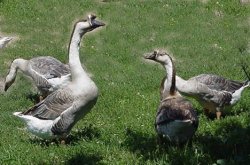
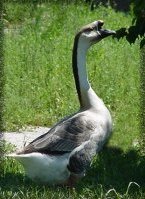
Brown Chinese Geese
Prices:
Goose Eggs: $2.50 each
Goslings: $10.00 and up - depending on age
Adults: $25.00 and up - depending on age.
Chinese geese are considered by many to be the most graceful and beautiful member of the goose family.
They are elegant and dignified on both land and water. Sometimes referred to as "Swan Geese" because of their
long and graceful necks, they, in fact, descend from the wild swan goose native to Asia (Holderread, 1986).
Chinese geese are exceptionally practical. Of all breeds, they are the best layers, most active
foragers, produce the least greasy meat, and, except for Pilgrims, are the easiest to sex at maturity
(Holderread, 1981). With good management, the average Chinese goose produces nearly twice as many goslings as other
geese, laying 40 - 100 white eggs annually. Because they are alert and vocal, they will raise the alarm if a
threat is perceived (Holderread, 1986). Geese eat many grasses and herbaceous plants. If properly managed they
can be employed as "weeders." "Chinese geese are by far the most popular breed for weeding chores due to their
active foraging habits, moderate size, unmatched agility, good availability and reasonable prices."
(Holderread, 1986). Poultry catalogs will commonly refer to this breed as "Weeder Geese."
The Chinese goose is refined and curvaceous. Its bill is relatively long and slender, with a large, rounded,
erect knob that attaches to its forehead. The Chinese holds its head high. Its head flows seamlessly into a long,
slim, well-arched neck which meets the body at about a 45 degree angle. Its body is short, compact,
has a prominent and well-rounded chest, smooth breast and no keel. Its abdomen is moderately full but has no
fatty lobes, except during the laying season when the female may develop a single lobe. The tail should be held
high, which is worth noting as this is a good indication of vitality in ganders. A Chinese goose is often heavier
than it appears, as its feathers are closely fitted. Mature ganders average 12 pounds, mature geese average
10 pounds (Holderread, 1981).
When selecting breeding stock, "pick birds with compact bodies, prominent chests and keelless breasts, wings
that fold in front of an erect tail, slender and symmetrically arched necks and large, rounded knobs that rise
well above the crown of the head. A spry, upright carriage, is important in Chinese since it is a sign of good
health and vigor. Avoid breeding from specimens with drooping shoulders, roach backs, deformed necks and long
bodies." (Holderread, 1981). A ratio of four to six geese per gander, rather than allowing a one to one pairing,
reduces competition in the flock (Holderread, 1981). The Chinese is a hardy breed, however their knobs which will freeze
when temperatures fall below 20Ì to 25Ì F (-5Ì C). It is important to provide the flock some protection during freezing
weather (Holderread, 1986).
There are two color varieties of Chinese geese, brown and white. The original variety is a rich brown and fawn,
accented by a dark, russet-brown neck stripe. In mature birds, the glossy black bill and knob are separated from
the main head plumage by a narrow band of creamy-white feathers. The shanks and feet are brownish orange or dark
orange and the eyes brown. The white variety has blue eyes, pure white plumage, and bright orange feet, knobs and
bills. While goslings of white European breeds are mainly gray with yellow trim, the down of day-old White Chinese
is a bright canary yellow (Holderread, 1981). Both varieties were admitted to the American Poultry Association's
Standard of Perfection in 1874 (Malone, et. al., 1998).
Chinese geese are a most economical breed. Stock are generally the less expensive than other breeds. Their smaller
size coupled with their active foraging ability means they do not require as much food as other breeds. For those
looking for "watchdogs" Chinese are an excellent choice for the home flock (Holderread, 1986).
We hope you enjoy our Internet site and welcome you to visit our Quaker Farm Shoppe where we look forward to serving you! Closed 1st Days (Sundays).
"The Lord bless thee and keep thee...."
- Numbers 6:24

|