Chemical free produce from the Quaker Farm Store!

Quaker Farm Home

Contact & Visitor Info


Free Range Eggs

Quaker Soaps

Wool & Fiber


Chemical free Hay

Garden Produce


Pastured Chicken

Pastured Turkey

Pastured Duck & Goose

Pasture-raised Beef

Pasture-raised Goat (chevon)

Grass fed Lamb & Mutton


Buff Orpington
Chickens

Border Leicester & Cotswold
Sheep

Saanen & Oberhasli
Dairy Goats

Checkered Giant
Rabbits


AKC Collies

Quaker Pantry
Recipes & more!

Simple Living Workshops
Quaker Hill Farm
Harrisville, Michigan
quakerfarm.com


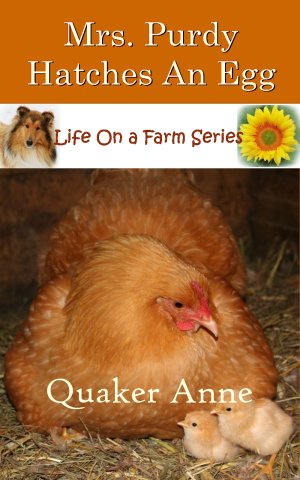
A Baby Chicken is Born at Quaker Hill Farm
A story for children written by Quaker Anne
This might be a good resource for young home schoolers - pass it on!

At Quaker Farm, we raise chickens. The chickens we raise are an uncommon breed called Orpingtons. Orpington chickens come in several colors and the color we have is called Buff. Buff Orpingtons are beautiful golden colored chickens that are gentle and kind in nature.

Female chickens are called Hens and male chickens are called Roosters. Female chickens begin to lay eggs when they are around 8 months old. They lay one egg every day. The first few eggs a chicken lays are tiny ones called pullet eggs. Once a chicken lays an egg, she quickly leaves her nest and walks around the barnyard cackling proudly to everyone announcing that she has laid an egg. When more than one hen lays an egg around the same time, they all cackle together and it is very noisy to hear!

Buff Orpington hens are very good mothers. When a hen decides she would like to be a mother, she begins to lay eggs in a nest that she builds carefully out of sight from everyone and all of the other farm animals. She finds a hidden place to nest where no one can find her and becomes broody. The eggs she collects in her nest are called a clutch. Sometimes a brooding mother hen is very hard to find because she hides so well. Why does she hide? Well, if no one can find her, then the hen feels that her newborn babies will be safe - that is how God created all mother chickens to think. So, all breeds of chickens do the same thing, every mother chicken hides her nest to protect her clutch of eggs as God designed them to do.

When a hen decides to set on her eggs, she fluffs herself up and cuddles all of her eggs under her, as close to her body as she can, and carefully sets on them until they hatch. She has become a broody hen and her eggs enter their incubation period. An egg needs to be warmly incubated for 21 days while the baby chick inside grows and develops. Every few hours, the hen must carefully turn her eggs. For all that time, the mother hen seldom leaves her nest. Only rarely does she go out to get something to eat and drink, but she returns quickly to her clutch of eggs. All of her energy and thoughts are concentrated on taking care of her precious eggs while she incubates them.

We have a hen at Quaker Farm named Miss Purdy. Miss Purdy disappeared one day and we could not find her. We wondered, "Where could she be?". We looked and looked all around but she was nowhere to be found. Even Lassie the Collie could not find her. Then suddenly one of the children called out, "Mama, I found Miss Purdy! She is here, way back in the barn hiding between some bales of hay!". We climbed up the hay mow and sure enough, there was Miss Purdy hiding on her nest cuddling her clutch of eggs to incubate them. Look closely and you can see Miss Purdy setting on her clutch of eggs.

Miss Purdy setting on her clutch of eggs We were very curious to find out how many eggs Miss Purdy was setting on so we gently moved her a bit to count them.

Can you guess how many eggs Miss Purdy was setting on? I'll give you a hint, it was more than all of the fingers that you can count on both of your hands! Click here to find out how many eggs Miss Purdy had.

We checked on Miss Purdy every day and made sure she had food and water near her nest so when she got hungry or thirsty, she would not have to go far to eat.


an egg begins to hatch

After several weeks, one morning a great miracle happened. One of the eggs had a small hole in it, a baby chick was hatching!

Hatching takes a long time and a baby chick has to work very hard to peck his way out of his egg. So, we waited for a few hours and checked for progress later in the afternoon.

When we later visited Miss Purdy, we politely asked her if we could see if her baby chick was done hatching yet. She pointed us to the egg the chick was working his way out of, and we got to look at his fine progress! Can you see the baby chick hatching? Now, look a little to the left and you will see a tiny fuzzy chick who allready hatched. Miss Purdy with new baby hatching

We knew it was important to be very quiet, and were grateful that Miss Purdy did not mind our being there.

After a few minutes more, we looked again and the little chick was even farther along on his hatching journey.


Baby Chick Hatching A baby chick has to work very hard to come out of his shell and hatching must be done slowly and carefully. No one can help a chick hatch because the process must not be rushed or interfered with. God planned it so that as a chick hatches slowly, he developes the last little bit he needs to, to be ready to live outside of his shell. If a person were to try and help a chick hatch, that chick would likely die. So, it is best for the chick if we trust in God's design for him to hatch on his own. Hatching Chick


Slowly but surely, progress is made. The baby chick starts to get his feet out so he can push his shell away bit by bit. Look closely, you can just see the toes of his little foot on the outside of his shell.


The baby chick begins to open his eyes!


baby chick hatching

He looks at us for the first time. He is almost done hatching. But we can only quietly look, we must not touch the baby.

You may have noticed that the chick looks like he is wet. Well, he is. Having incubated inside his shell, a little chick is quite damp when he first hatches, but snuggled under the warm feathers of his mother, he quickly dries off after hatching and becomes a dry fuzzy little chick rather quickly.
Hen and chick
Miss Purdy finally set herself gently back onto her baby and asked us to be patient and wait. When the baby chick was finally done hatching and was completely dry and fuzzy, he came out to say "Hello" to his mama for the very first time. Miss Purdy was very proud of all of the hard work her baby had done and was very happy to meet him.

Miss Purdy smiled at her new baby and told him he was a good boy.


Hen and chick


Then the baby chick looked at us and wondered who we were. We did not look one bit like his pretty mama and we seemed odd to him because we didn't even wear feathers.

He was so cute! We named him Charlie.


Hen and chick

Suddenly, Miss Purdy clucked to baby Charlie and told him to go back under her feathers where it was nice and safe and warm. He obeyed his mama quickly without having to be asked twice.

Then, Miss Purdy asked us to leave her with her new family and thanked us for visiting.

Have you ever wondered what the inside of an egg looks like once a baby chick hatches? Click here to look at Charlie Chick's egg after he hatched.


Return to Quaker Anne's Children's Stories

Return to Quaker Hill Farm Homepage


We hope you enjoy our Internet site and we hope you will visit again.

"The Lord bless thee and keep thee...."
- Numbers 6:24