If this site has been helpful to you, please
donate to help support it.
Feeding an Orphaned Lamb
Instructions for how to bottle feed lambs (works for goat kids and piglets too!)
By Quaker Anne
I don't claim to be an expert. The following information and techniques are
based on our over 25 years of experience and
have proven successful at our farm. It is interesting to note that some of the most successful and certainly
most friendly 4-H livestock projects
our children ever worked with were bottle fed lambs, dairy goats, piglets. Video is first, text and pictures are below.
How to Bottle Feed an Orphan Lamb Video
(lamb runs after Willow the Collie at the end - very cute!)
turn off page sound to hear video by pressing the x above. You can also view this video
at The Quaker
Kitchen site without background sound.
When raising sheep, it is best to be prepared for day you will encounter an
orphaned lamb,
also known as a
bummer lamb. A lamb can become orphaned in the obvious case of a ewe dying, but,
they are sometimes orphaned for no
apparent reason when their mother rejects them and refuses to allow them to nurse.
This can happen in the
case of a maiden ewe (first time mother), or a multiple birth (twins or more), a ewe who doesn't
produce enough milk
or, for reasons never to be apparent. Occasionally, a ewe becomes agressive about
rejecting her lamb and forcefully butts the baby away. Injury can easily result in this case.
The situation should be noted as soon as possible after birth so that intervention can be swift and successful.
The first and most important thing you will do is be prepared. The time to acquire your supplies
is not
in the middle of the night when you need them. Think ahead. There aren't many things to acquire but you want your supplies
gathered together into
one place - such as a designated tool box - and stored for easy access and handy use.
Supplies should include:
Nipples. They come in several types but we prefer using lambar nipples so we can transfer them from
a bottle to a lamb nurser
using the same nipple they are familiar with.
DO NOT clean your bottle nipples
with a bleach solution no matter how mild it is. Bleach will ruin them.
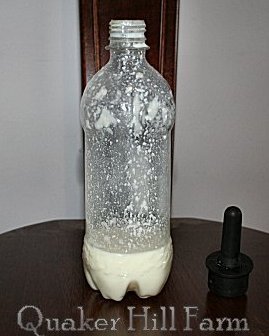
Clean feeding bottle. A small 12 ounce soda bottle is best at first, keep the cap so you can store unused
amounts in the refrigerator between feedings. After about a week you might want to change to a 2 liter soda bottle.
Milk Replacer. Dry, fresh or frozen. DO NOT use calf milk replacer or any milk replacer made with
soy protein. Newborn animals can not digest soy protein easily if at all, so they wind up starving to death
on a full stomach. Use only the best quality powdered milk replacer made specifically for lambs - it is made with milk
that you should have good success using it. Also, try to find someone in your area who raises goats and ask to purchase a pint of colostrum which you can
freeze. One method that works well is to freeze fresh colostrum in an ice cube tray, remove cubes as soon as
frozen and store them in a double freezer bag or thick, tightly sealed container. Then you can use
a few (4 or 5) cubes of this liquid gold as an initial first feeding then add 2 or 3 cubes to
a cup of formula made with powdered lamb milk replacer. This provides a great start to a baby
unable to have colostrum directly from its mother.
Clean bath towel to cover your lap and use as a baby napkin.
Basically, what you are going to do is teach a lamb to accept being bottle fed. With gentle
encouragement and patient, loving persistence, the new baby will master the knack of it in as
little as a few minutes or
at most a day or two.
The initial acceptance of being bottle fed has a lot to do with the age a lamb is
introduced
to a bottle in the first place. If a lamb is a day or two old and has already nursed on
its mother, it takes a bit longer for them to make the adjustment to a nipple. Ideally, you want
the baby to nurse on its mother at least once and get a good feeding of colostrum. Colostrum is
the
precious first milk that is produced only in the first 48 hours after birth which is full of
important antibodies that newborns must have, if
at all possible, to help protect them from infectious organisms. Colostrum also is very high in fat, protein (up to 8 times more than normal
ewe milk) and nutrients and it has a important laxative effect on newborns that helps them pass their first stool (bowel movement) known as
meconium.
The most difficult part for the lamb during this learning process is the unfamiliarity of a thick rubber object being inserted
into its mouth. Artificial nipples are not only considerably larger than a natural mama's, but they
also have an unpleasant taste and texture being synthetic. Understanding this will help you
to be more gentle about the process of adjustment for the baby.
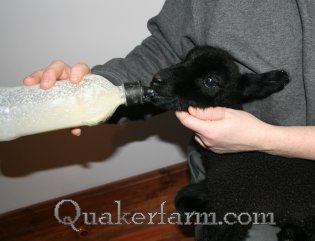
To begin, hold a lamb securely on your lap on top of your towel. He may struggle a bit for a moment but be firm in holding him and he will settle in.
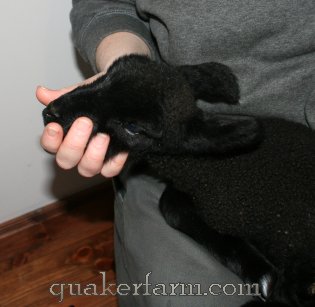
Next we gently stroke his muzzle to encourage him to relax and to initiate the sucking reflex. This is a comforting
exercise that helps the infant focus on the task at hand.
When this is done correctly and for long enough...

 Next we gently stroke his muzzle to encourage him to relax and to initiate the sucking reflex. This is a comforting
exercise that helps the infant focus on the task at hand.
Next we gently stroke his muzzle to encourage him to relax and to initiate the sucking reflex. This is a comforting
exercise that helps the infant focus on the task at hand.
 When this is done correctly and for long enough...